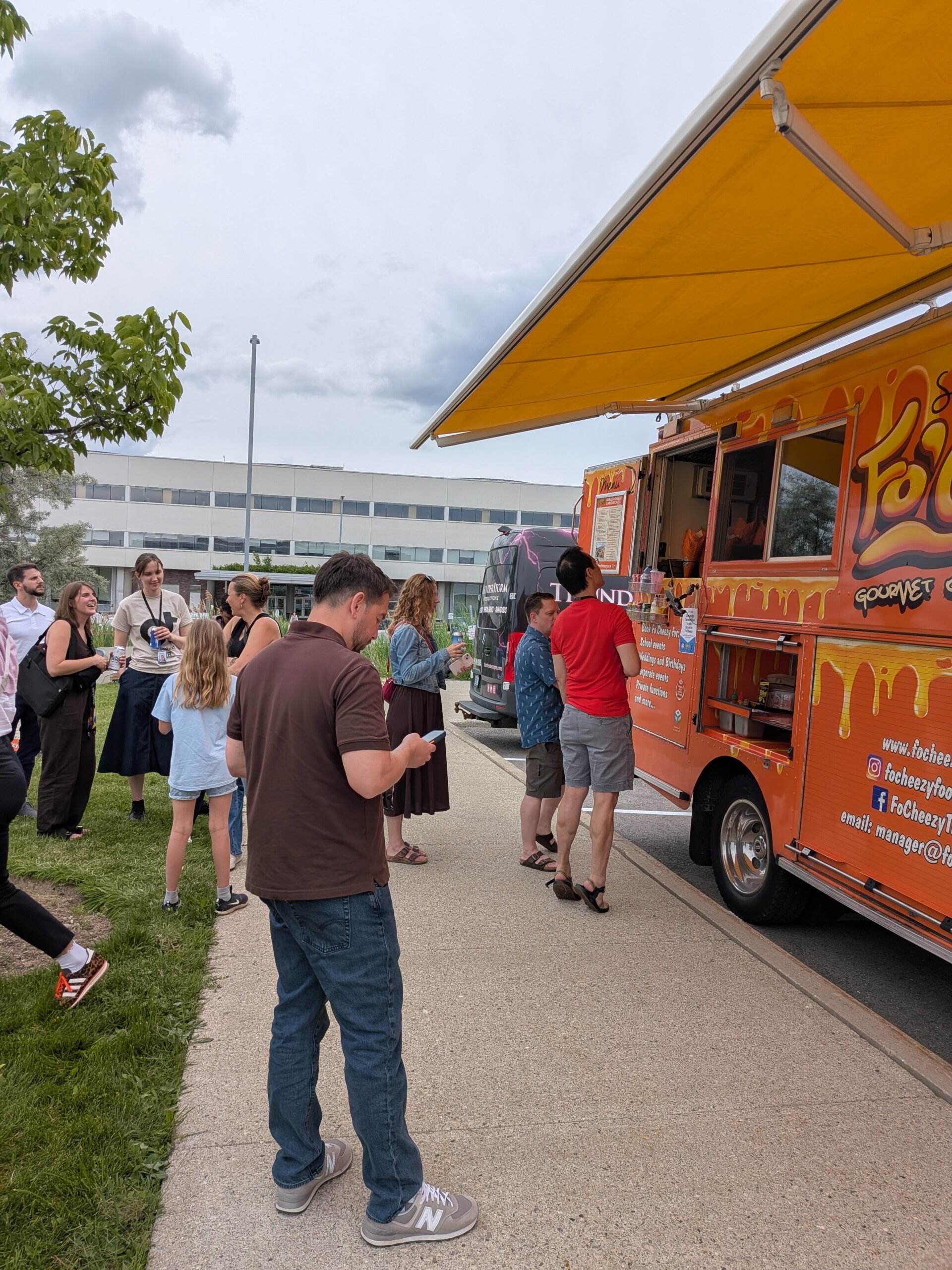
Join Us on October 1 for a Fo’Cheezy Lunch and Stay for Parktoberfest!
Start with lunch and stay for the festivities! 🍴 12:00 – 2:00 p.m. | Lunch with Fo’CheezyGrab a delicious lunch…
By: Lee Faris
Companies around the world are seeking new ways to connect with top talent- and co-op programs are becoming an increasingly viable way to bridge that gap. David Johnston Research + Technology Park’s location makes it ideal for putting industry-leading tech companies in close proximity to top talent. Increasingly, students are turning to companies in R+T Park for close-to-home co-op opportunities that leave them with long-lasting industry connections.
“Co-operative education creates meaningful value on both sides.”
Kristina Tubbs, Partner, EY
The co-op program provides benefits for both students and employers. Stantec hires co-op students both in and outside of their research park location. While they provide co-op students with stable wages, work experience, and employment, Stantec’s Waterloo Office Leader Dave Williams thinks co-op students also offer high value.
“Co-op students are a valuable asset to our teams, bringing fresh ideas, technical skills, and enthusiasm to their work,” adds Williams. “Hiring co-op students also allows us to invest in and develop the next generation of talent for Stantec.”
Qorsa has partnered with the University of Waterloo as well, providing students with real-world experience through their co-op jobs. Their CEO, Terry Popowich commented. “Each term we bring on around 30 students, many from Waterloo, with others from the University of Toronto and McMaster, and they consistently strengthen the team while opening room to test bold new ideas. Programs like this are also how we keep world-class talent building high-tech here in Canada.”
EY partner Kristina Tubbs spoke about the dual value of the co-op program. “Co-operative education creates meaningful value on both sides,” she said. “Students gain real-world experience, practical training, and a clearer understanding of how their studies apply in a professional environment, while our teams benefit from their curiosity, fresh perspectives, and insights into emerging technologies.”
Judene Pretti, the Interim Associate Provost for Co-operative and Experiential Education, graduated from the co-op program herself. She has worked on campus for 28 years, spending the past 20 years working in a variety of roles across the co-op and experiential education portfolio.
“I love the opportunity to see students talking about what they’ve contributed in their work terms, what they have learned and how the experiences have shaped their thinking about what their next steps might be,” Judene said. “Then we get to be out having conversations with employers and seeing the enthusiasm that they have for the students that come into their teams.”
“Our support goes much, much further than the traditional checklist of a career or a co-op center.”
-Judene Pretti, Interim Associate Provost, Co-operative and Experiential Education
In addition to the support co-op students receive from their employers and fellow students, they benefit from a variety of supports from CEE. Judene commented on the evolution she has seen in the program throughout the years.
“What I’ve seen over my time in CEE is a continual evolution in how we support students. While helping students secure meaningful work opportunities remains at the heart of what we do, we’ve expanded our focus to think more holistically about student learning, development, and success through experiential education.”
She went on to highlight the supports offered, which include faculty-specific co-op advisors, career advising and workshops, professional development courses, employer info sessions, and events.
“Our support goes much, much further than the traditional checklist of a career or a co-op center,” she commented. “It really is intended to support the students in this journey over the course of their work terms.”
SAP’s User Assistance Developer and co-op student Anne-Katherine Le agrees that co-op programs are a great way for students like her to learn- without the pressure of a permanent position.
“For someone that’s first stepping into the corporate workplace, it’s nerve-wracking,” she commented. “You don’t really know you’re doing. Being a co-op student is a safety net where you can say, ‘it’s okay that I don’t know what I’m doing because no one expects me to know what I’m doing. I’m here to learn.’”
“They’re interacting with professionals in roles that they may or may not have imagined for themselves.”
-Judene Pretti, Interim Associate Provost, Co-operative and Experiential Education
When Le started co-op, she never expected she’d be working for a tech company.
“I’m in the arts and business program studying sociology, so I think that’s a bit out of the ballpark for tech jobs,” she shared, “but for my last co-op I worked IT for campus wellness at UW.”
For Le, the co-op program has provided an opportunity to combine her interest in technology with her love of working with people, and academic focus on sociology.
“Growing up technology was always a pastime interest of mine,” Anne commented. “When I started studying sociology, I thought I had to shut down my tech interests because all that is for comp sci or mathematics. So when I got my first IT job, last co-op, I thought it was cool because I could combine people and tech.”
Pretti sees this opportunity for exploration as one of the most important parts of the co-op program. At Waterloo, students are allowed 4-6 co-op terms, where they can try out various jobs and workplace environments. This allows them to explore new career options, and apply their skills in ways they otherwise may not have thought possible.
“I think the more students approach co-op as an opportunity to learn about themselves, to figure out what interests them and what passions they have, the more successful they will be,” she told us.
Co-op also comes with opportunities for travelling, and exploring what it means to live in other countries in a more long- term context than vacationing provides. This can expand professional networks in unexpected ways, and foster stronger intercultural communication skills.
“I think there’s value in exploring different regions, getting to see a little bit about what it would be like to live in other places,” Judene says. “Also the idea of the professional network that they’re building. They’re interacting with professionals in roles that they may or may not have imagined for themselves.”
“They start connecting those dots and they start seeing opportunities for innovation”
-Judene Pretti, Interim Associate Provost, Co-operative and Experiential Education
Co-op at Waterloo encourages entrepreneurship through the option to do an Enterprise Co-op (E co-op). If students know what they would like to build a company on, they have the option to do so for 4 months with support and mentorship. They also have the option to work in startups, giving them a hands-on introduction to entrepreneurship.
“When a co-op student is graduating, they can speak to both the breadth and depth of experience that they offer.” Judene commented. “I think that’s in some ways connected to the innovation concept, which is interesting with R+T Park, where students are getting exposed to different ideas and different work experiences, they start connecting those dots and they start seeing opportunities for innovation.”
Pretti spoke on the value co-op students can provide to small and medium-sized businesses and startups when they are given the funding to hire co-op students.
“I think we could put more focus and attention on the kinds of supports that startups or small to medium businesses need from co-op when they may not have previously accessed co-op students,” she said. “Those are a couple of areas where there’s some real opportunity and those get me excited,” she said.
“There is a huge opportunity for students to be those agents of change within organizations as they’re adopting AI in a responsible, ethical way.”
-Judene Pretti, Interim Associate Provost, Co-operative and Experiential Education
In the midst of a changing workplace, AI integration is a hot topic in many workplaces. Pretti sees opportunities for co-op students to help workplaces integrate AI.
“Where I see the opportunity,” she explains, “is students are poised to provide support and leadership in ways on the topic of AI that our economy and our province and country need. And so there is a huge opportunity for students to be those agents of change within organizations as they’re adopting AI in a responsible, ethical way.”
Le thinks the bridge co-op creates between the arts and social sciences and the tech sector pave the way for more ethical AI integration.
“I think that there needs to be some sort of human integration behind AI,” she commented. “Students can adopt a different viewpoint of AI that many people lack when they think it’s only about robotics and not ethics, or there’s no one behind it.”
“You never know how far authenticity will take you, instead of being who you think people want you to be.”
-Anne Le, User Assistance Developer (co-op), SAP
Le thinks authenticity is one of the important things for incoming co-op students to practice.
“Be authentic in your interviews and in your resumes,” she suggests, “and also when meeting people. You never know how far authenticity will take you, instead of being who you think people want you to be.”
Pretti agreed with Le’s sentiment, further highlighting the value of co-op students’ willingness to learn, try new things, and put themselves out there.
“The advice I would give to co-op students is to go into your work ready to learn, looking for ways that you can contribute and be open to discomfort. One of the professors we worked with in engineering used to say that co-op was the return on investment of discomfort. When we see what co-op students accomplish, that growth is remarkable. But that growth doesn’t happen without the students’ investment of putting themselves out there and trying things they may not realize they’re capable of or interested in.”